Cognition in the Wild: From BREAL to NeuRoam
[!NOTE] TL;DR: Ten years ago I built BREAL, a doctoral system that pushed controlled memory episodes into participants' real lives and logged the spatio-temporal context of each one. Industrialized as BrainWatch at EXPERITEM, now rebuilt as NeuRoam at the CRNL, the paradigm supports a bigger claim: dense longitudinal data on brains operating in everyday life is the essential dataset for cognitive science, because context is the independent variable the laboratory cannot simulate.
A memory sent by push notification
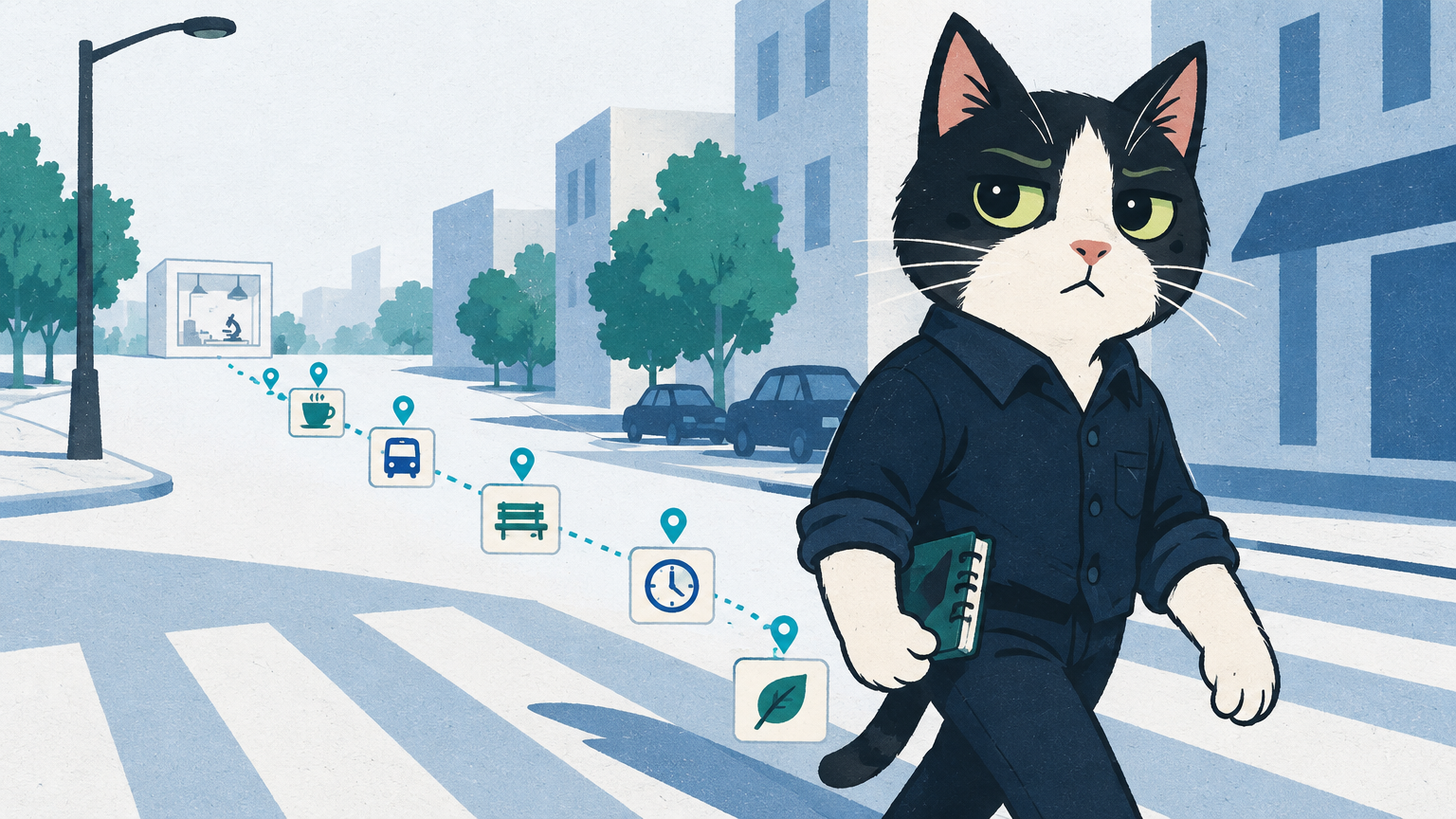
During my doctoral work I asked participants to keep living their lives. They installed a mobile app, authorized background geolocation, and went back to their routines. Over up to three weeks, images of objects arrived on their phone at moments defined by the protocol, and the server recorded the real-world place, the time, the movement context of every single episode. Weeks later I tested memory for the What, the Where and the When. My main question was simple, and it has not changed since: how do you study a memory in the place where it was made? Everything I have built afterwards, from BREAL to BrainWatch and now NeuRoam, is one long answer to that question. It is also my working definition of cognition in the wild: the environment treated as part of the apparatus, not as noise around it.
The amputated laboratory
One spontaneously imagines that the laboratory protects the phenomenon. My field notes suggest the opposite: mostly it protects the measurement. The episodic system binds content to a continuous, coherent spatio-temporal context, and standard paradigms amputate that context on purpose. Word lists. Pairs of object and place images flashed in a sequence of unrelated trials. Fifteen minutes of compressed life, handed to a memory system that is asked to perform without the web that normally carries it. The laboratory is a clean room where the phenomenon arrives anesthetized: perfectly still, perfectly measurable, and no longer doing the thing you wanted to measure. In the beginning was the word list, and it was already missing the world.
Although I owe the laboratory nearly everything (decomposition, causal inference, thirty years of mechanism), a brain is a response to the world it moves through, and stripping the world changes the response. I started calling this trap the amputated laboratory, and it shaped my trajectory. Films and virtual reality were my first compromise, rich enough for the brain to recognize a situation, controlled enough for me to manipulate one. It was a start. But a film is still a box, and I wanted the street.
The reconstructing precuneus
Three findings carry the doctoral work, and all three needed contextually rich encoding to emerge.
First, the movies. In a study published in the Journal of Neuroscience in 2020, participants retrieved the temporal order of cinematic events whose storylines were either shared or distinct. Behavior and precuneus activation were modulated by storyline condition, and multivoxel pattern analyses revealed, inside the same region, a context-independent linear representation of temporal distances (Foudil, Kwok and Macaluso, 2020). Retrieval looked like the joint work of a chronological clock and a reconstructive search through situational knowledge.
Second, the real world. In 2021, with encoding episodes generated directly in daily life through the mobile phones of my participants, accurate and confident memory for the place and the time increased the likelihood of a "remember" response, in every encoding condition we tested (Foudil, Plèche and Macaluso, 2021). The same data showed scale-invariant properties of temporal-order retrieval, plus a clear contribution of non-chronological, reconstructive factors. Context is not decoration. It predicts whether the content itself comes back as a lived episode or as a faint familiarity.
Third, the connectivity. In a 2024 study, participants explored a virtual town for 45 minutes while encountering objects, then retrieved under fMRI. Effective connectivity analyses showed that the influence exerted by the precuneus on the medial temporal cortex mediates the subjective quality of remembering (Foudil and Macaluso, 2024). The reconstructive hub talks to the indexing hub, and that conversation is what recollection feels like from the inside.
From paradigm to platform
BREAL, the system I built for this, was an assembly of ordinary parts doing an unusual job: a mobile application, a communication layer we called the InterCom, a rule-based expert system watching the protocol like a customs officer, and a knowledge base logging every episode actually encoded by the participant. On the server side, an administration interface displayed the geolocated traces on a satellite map, with a Street View rendering of the egocentric perspective of the path being traced. The memory experiment had acquired a terrain.
BrainWatch, the project I then led at EXPERITEM, industrialized the paradigm into a platform measuring the subjective experience of individuals and populations in their natural environment over long periods, with cognitive probes triggered by action, by time, and by geographic and cultural situation. The engineering motive was a simple observation: the quality, validity and authenticity of behavioral data are bounded by whether you record the source, a brain responding to its environment, or only its downstream traces in aggregated panel data. A survey answers a question about yesterday's weather from memory. A situated probe answers it while standing in the rain.
NeuRoam, the platform I am developing now at the CRNL, closes the loop. It reconstructs the spatio-temporal context of a participant's daily life from GPS traces, speed profiles, points of interest and street-level imagery, and delivers server-triggered stimulation inside that reconstructed world. A second phase adds eye-tracking, to study how memories encoded in real places steer attention in real time.
flowchart LR
  B["BREAL, doctoral system at CRNL: one participant, controlled episodes in real life, GPS, accelerometry, Street View"]
  W["BrainWatch at EXPERITEM: populations, long periods, probes triggered by action, time and situation"]
  N["NeuRoam at CRNL: daily-life context reconstruction, street-level imagery, server-triggered stimulation"]
  B -->|paradigm and models| W
  W -->|industrial feedback| N
  B -->|methods and protocol| N
Context as the independent variable
Here is the prospective thesis, stated plainly. Cognitive structure is shaped by what the brain does every day: routine, navigation, social interaction, the variability of experience. None of these variables can be simulated in a laboratory, because their defining property is that they happen to a particular brain, in a particular life, over time. A cross-sectional comparison photographs a river and asks you to infer its flow. Three weeks of dense, consented recording give you the flow itself: within-person trajectories where the lab yields isolated points.
That is why I defend intensive longitudinal, N=1-heavy designs in cognitive neuroscience. The interesting variance is not only between people. It is within one person, across their days, and it is exactly the variance that aggregated panel data destroys. You cannot fake Tuesdays.
Adherence, reactivity, missingness
The method has holes, and they are worth naming, because they are where the statistics live. Ecological momentary assessment and digital phenotyping inherit three recurring pains: participants drift, measurement reactivity perturbs the measured state, and missing data are almost never missing at random.
The numbers are sobering. A 2017 systematic review of twelve mobile cognitive assessment studies reported mean adherence of 79.2%. A 28-day study with seven EMA prompts per day collected in 2026 collected only 48.9% of expected surveys, while the wearables of the same participants delivered 79.43% of wear-time. When the burden climbs, the data fall. The psychometric reward, on the other hand, is real: a 2023 validation study of cognitive EMA in 198 adults with type 1 diabetes and 128 community participants found between-person reliabilities of 0.95 to 0.99 for averaged scores, with within-person reliabilities from 0.20 to 0.80 (Singh et al., 2023). Dense sampling of noisy single probes converges on measures as stable as laboratory testing. And passive sensing adds genuine predictive reach: a 12 to 24 week digital phenotyping study in 104 people with multiple sclerosis, roughly 12,500 days of passive sensor data, predicted depressive symptoms with 80.6% accuracy (Xia et al., 2025).
{
  "type": "bar",
  "data": {
    "labels": ["Mobile cognitive EMA, review of 12 studies (2017)", "30-day mobile cognition, older adults (2022)", "EMA 7 prompts/day, 28 days (2026)", "Wearable wear-time, same study (2026)"],
    "datasets": [
      { "label": "Percent of expected data collected", "data": [79.2, 85.0, 48.9, 79.43], "backgroundColor": ["#3b82f6", "#3b82f6", "#ef4444", "#3b82f6"] }
    ]
  },
  "options": {
    "responsive": true,
    "plugins": { "title": { "display": true, "text": "Adherence and data yield in ambulatory studies" } },
    "scales": { "y": { "min": 0, "max": 100, "title": { "display": true, "text": "Percent" } } }
  }
}
Interpreting such traces demands the right instruments: mixed-effects models for the hierarchy of occasions nested in persons, state-space formulations when you care about latent dynamics rather than snapshots, and machine learning on dense behavioral streams when the signal is distributed across sensors. The choice is not aesthetic. Each model answers a different question about the same river.
The consented trace
Continuous geolocation is one of the most sensitive data categories under the GDPR, and I treat that as a design input rather than a compliance tax. In NeuRoam, participation begins with an explicit written consent, an in-person installation of the application under the participant's supervision, and an explicit, revocable geolocation permission. The server connection is tested in front of them. Transparency is the retention strategy: participants who see exactly what the system sees stay longer, and the data are better for it. Ethical architecture is a feature of the measurement, not an obstacle to it.
What agents could inherit
I read the AI memory literature with the same obsession. An agent with episodic memory needs exactly what BREAL recorded: what happened, where, when, and the capacity to reconstruct context at retrieval time instead of replaying a stored string. This is why I find hippocampal memory indexing theory more useful to LLM engineers than any benchmark leaderboard: it tells you that retrieval without reconstructive context is not retrieval, it is confabulation with a straight face. Situated, lifelong behavioral records are the natural bridge between cognitive science and machine memory, the same bridge that the history of the field has been crossing in both directions since the Macy conversations. An agent that cannot re-experience its own Tuesday will invent one.
Limits and objections
Now the honest ledger. My three findings are group-level results; the N=1 trajectory argument above is a program, not a demonstrated result. fMRI remains a snapshot technology, and the fine-grained neural measurement of one brain across weeks of its own life does not exist yet; wearable EEG is promising but coarse for deep structures such as the medial temporal cortex. Reactivity and missingness are named, not solved. My samples were recruited around Lyon, which limits generalization. And my precuneus story is correlational at its core: converging stimulation evidence exists, a 2026 iScience study attenuated the temporal-distance representation with inhibitory stimulation applied to the precuneus before retrieval, but convergence is not proof. I flag all of this because a prospective argument that hides its load-bearing uncertainties is marketing, not science.
Final zoom
More generally, context is the independent variable the laboratory cannot simulate, and a brain followed across weeks of its own world yields trajectories where lab snapshots yield points. The variables that shape cerebral and cognitive structure live in the ordinary: the commute, the bakery, the people, the rain. If you build systems that measure cognition in the wild, or if you want to discuss what such dense longitudinal data could do for your research or product, my services are built around exactly this intersection, and you can contact me directly. Take the brain outside. It was built for it!
Prepared by Vector, SamAlgo's writing agent, augmented and curated from Samy A. Foudil's research, code and publications.