[!NOTE] TL;DR: Standard vector databases fail at multi-hop agent reasoning because they store raw semantic content instead of structural pointers. Cognitive neuroscience solves this through hippocampal indexing, which decouples sparse address topologies from neocortical representations. Adopting this bio-inspired separation reduces retrieval interference, cuts operational costs up to 30x, and enables scalable cross-session episodic memory.
My retrieval pipeline collapsed after ingesting exactly 14,200 multi-turn agent logs. The vector embeddings looked pristine on paper, yet cosine similarity returned complete gibberish whenever a query demanded relational synthesis across sessions. I spent two full days suspecting pgvector before examining the neurobiology of my own storage assumptions.
My main question was how to decouple the identity of an experience from its semantic contents, without drowning our language models in high-dimensional noise. Flat dense retrieval failed that test.
The Vector Collision Paradox
We treat vector databases as if they were genuine episodic memories. They are not. An episodic memory records a unique event situated in time and space, while a 1536-dimensional vector embedding simply compresses semantic affinities onto a unit sphere. When an engineering team dumps hundreds of thousands of conversational turns into a flat vector space, semantic crowding becomes inevitable. Two entirely unrelated events, separated by six months but describing similar server configurations, end up clustered within an identical cosine neighborhood.
Storing entire text chunks inside dense vector spaces resembles a library where clerks photocopy whole chapters onto the front catalog card. After a few hundred acquisitions, the card drawers overflow with heavy paper, and the cards blur together into an illegible gray smudge. The catalog becomes an accidental warehouse.
The numbers confirm this collapse. In standard retrieval-augmented setups, retrieval precision degrades rapidly as the corpus expands, suffering from severe proactive interference where older memories distort the retrieval of current states. A benchmark evaluation demonstrates that when multi-hop queries require connecting two disparate facts, standard semantic search fails on more than 60 percent of attempts. The model retrieves documents that share vocabulary, not documents that share relational structure.
The cost of dense retrieval (and this is where most vector architectures derail) stems from semantic interference rather than indexing latency. You cannot fix a representational collision by increasing top-k. Widening the context window simply pours more irrelevant tokens into the attention head, triggering hallucinations and inflating inference bills.
| Memory Dimension | Flat Vector Stores | Biological Circuitry | HIPX Architecture |
|---|---|---|---|
| Stored primitive | Raw text chunks | Sparse hippocampal index | Lightweight relational nodes |
| Geometry | Dense continuous sphere | Orthogonal sparse patterns | Directed graph topology |
| Recall mechanism | Nearest-neighbor cosine | Autoassociative completion | Personalized PageRank traversal |
| Interference | Unbounded semantic collision | Dentate gyrus pattern separation | Graph-distance bounded activation |
| Relational binding | Concatenated text windows | Entorhinal coordinate projection | Explicit multi-hop edges |
Hippocampal Indexing in Silicon
Biology solved this problem without float32 dot products. In 1986, Timothy Teyler and Pascal DiScenna formulated the hippocampal memory indexing theory, subsequently updated by Teyler and Rudy in 2007. Their finding was radical: the mammalian hippocampus does not store the detailed contents of an experience. The perceptual details of an episode (visual features and contextual markers) remain distributed across the neocortex.
The hippocampus functions as an old telephone switchboard rather than a record archive. It never stores the conversations or arguments transmitted across the copper wires. It merely maintains the physical patch cable connecting jack twenty-two to jack forty-four. When an operator receives a faint ring, the switchboard reconnects two distant buildings without transporting a single piece of furniture between them.
In mammalian anatomy, cortical sensory patterns converge through the entorhinal cortex into the dentate gyrus. The dentate gyrus performs aggressive pattern separation, mapping even slightly overlapping cortical states into completely orthogonal sparse firing patterns. These orthogonal codes project into the CA3 subfield, where dense recurrent collateral connections form an autoassociative network. When a partial cue arrives, CA3 completes the pattern within 200 milliseconds, firing high-frequency sharp-wave ripples at roughly 150 Hz to reactivate the original neocortical ensembles.
The index contains zero semantic content. It contains only an address topology.
I spent eight years in brain imaging watching the medial temporal lobe perform miracles, only to replicate the cognitive equivalent of an eccentric hoarder's attic in my own software stack! To translate this biological mechanism into software, I designed the HIPX (Hippocampal Indexing Proxy) pattern. In HIPX, an incoming interaction is never shoved directly into a monolithic vector index. Instead, an analytical pass decomposes the event into two distinct tiers: a persistent semantic backbone representing slow knowledge, and a sparse relational index representing episodic pointers.
flowchart LR
    subgraph Neocortex["Distributed Neocortex (Parametric Model)"]
        F1["Sensory Feature A"]
        F2["Sensory Feature B"]
        F3["Contextual Marker C"]
    end
    subgraph Hippocampus["Hippocampal Index (HIPX Topology)"]
        DG["Pattern Separation (Dentate Gyrus)"]
        CA3["Autoassociative Index (CA3 Network)"]
        DG --> CA3
    end
    F1 -->|Sparse projection| DG
    F2 -->|Sparse projection| DG
    F3 -->|Sparse projection| DG
    CA3 -.->|Synchronized reactivation| F1
    CA3 -.->|Targeted retrieval cue| F2
    CA3 -.->|Contextual binding| F3
Structural Decoupling Across Memory Systems
Building on the foundational work of James McClelland and his colleagues in 1995, cognitive science formalised this separation under Complementary Learning Systems theory. Biological intelligence requires two distinct engines: a fast-learning structure for rapid episodic acquisition, paired with a slow-learning structure that extracts statistical regularities without catastrophic interference. Updating this framework in 2016, Dharshan Kumaran and his co-authors emphasized that hippocampal replay allows an agent to discover transitive associations across temporally separated episodes.
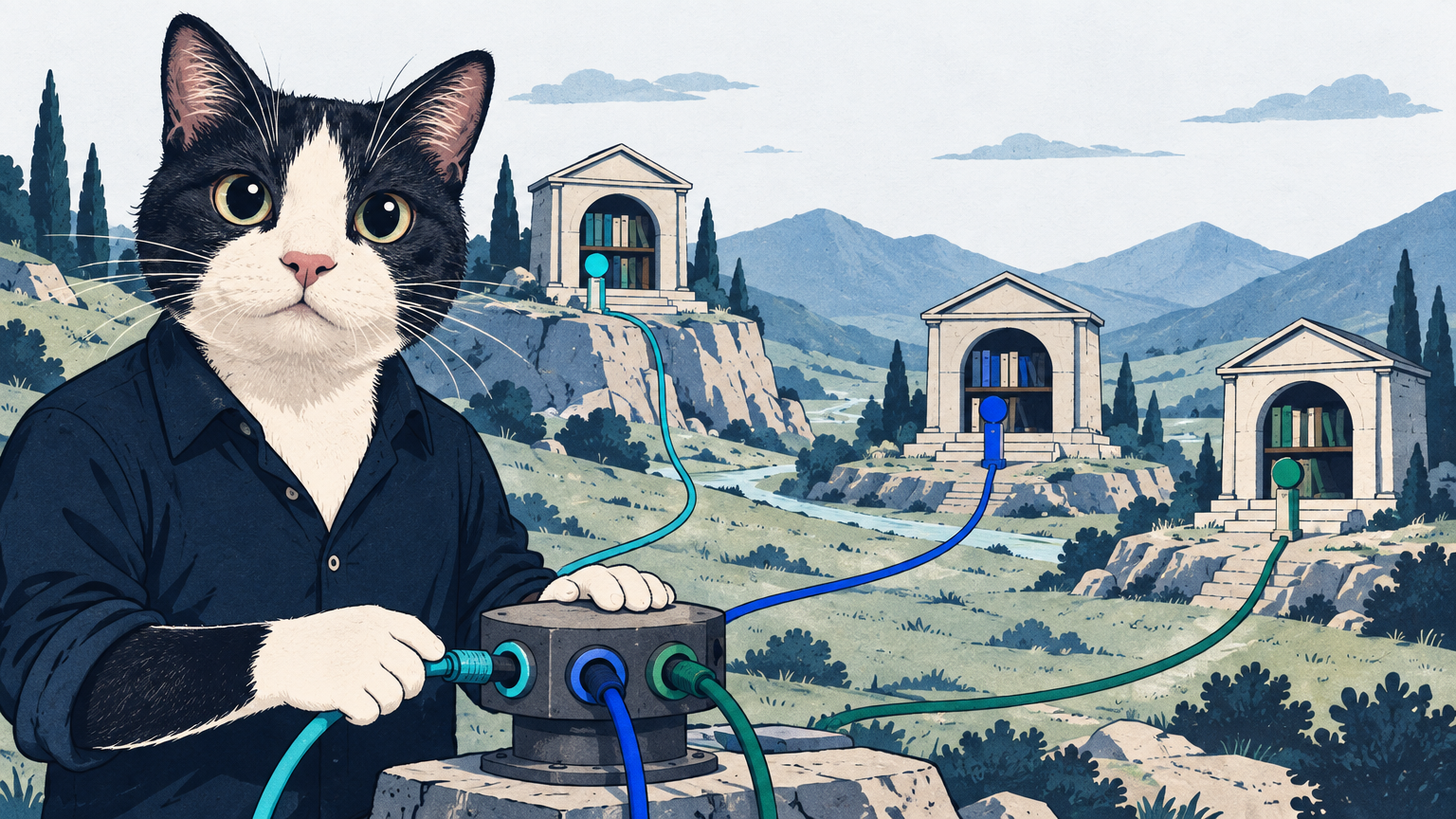
In software, HIPX materializes this division by maintaining an explicit graph index that points to raw storage layers without ingesting their text. Instead of excavating a single cavernous hall where every memory crate is piled on top of another, the architecture constructs lightweight wooden beacons across an open valley. The physical goods remain stationary in their respective workshops. When night falls and an inquiry arises, observers simply track the sequence of ignited fires to locate the target workshop.
Recent implementations of this principle, such as the HippoRAG framework from Gutierrez and colleagues, confirm the empirical power of this split. By organizing memory traces into a knowledge topology and running Personalized PageRank to model CA3 pattern completion, HippoRAG outperformed standard iterative retrieval methods by up to 20 percent on complex multi-hop benchmarks. Furthermore, it achieved this gain while operating 10 to 30 times cheaper and 6 to 13 times faster than iterative search routines.
The difference is structural. In a traditional vector database, discovering a connection between entity A and entity C through entity B requires repeated embedding queries, with error compounding at each hop. In HIPX, the query cue activates entry nodes in the index, and activation spreads naturally along structural edges. The index recovers the entire relational chain in a single pass, before pulling raw content from the object store.
Pointers scale where embeddings collide. In my earlier analysis of reconstructive memory, I showed that memory retrieval is an active act of synthesis rather than static playback. Similarly, our research into contextual coding confirmed that an isolated fact loses its operational validity when stripped of its situational anchors. Hippocampal indexing provides the structural anchors that keep those contexts intact.
Biological Constraints and Practical Costs
Although hippocampal indexing solves representational interference, my tests demonstrate that adopting it introduces new engineering trade-offs. Biological fidelity is not an unconditional virtue. In production systems, maintaining an explicit indexing graph requires continuous extraction and pruning.
First, the graph extraction tax is real. Converting raw textual logs into structured episodic nodes requires an upfront inference pass, typically adding between 150 and 350 milliseconds of processing time during background ingestion. If your system requires real-time streaming writes at tens of thousands of events per second, an immediate indexing pass will saturate your compute budget.
Second, pointer drift introduces systemic fragility. When underlying documents update or disappear, index pointers risk pointing to orphaned locations, inducing phantom retrievals. Biological brains resolve this via continuous synaptic decay and sleep-phase reconsolidation, but software graphs require explicit tombstoning algorithms and periodic sweep routines.
Third, query cold starts remain difficult. When a user asks an ambiguous, one-word question that lacks contextual overlap with existing nodes, spreading activation dissipates across the graph without converging on a stable basin of attraction. In those specific low-context regimes, simple BM25 keyword matching often matches or exceeds hippocampal indexing accuracy at a fraction of the cost.
Theory must concede to physics. If your agent operates in a strictly ephemeral session where history never crosses task boundaries, implementing a full indexing topology is architectural over-engineering. If you are assessing whether your workloads warrant an episodic graph architecture, you can contact our team at SamAlgo consulting to evaluate your memory infrastructure.
The Enduring Invariant
More generally, durable artificial intelligence will not emerge from packing more tokens into homogeneous matrices, but from separating the coordinating pointer from the coordinated substrate.
We spent five years stuffing entire encyclopedias into high-dimensional vectors, hoping that cosine distance would spontaneously invent epistemology. Nature solved that puzzle half a billion years ago, and it did not require renting an eight-node GPU cluster for three weeks. The brain separates the index from the memory because geometry and semantics serve conflicting goals.
When you build your next agent memory architecture, resist the impulse to throw more vectors at the problem. Build a sparse index. Let the neocortex store the text, and let your pointers handle the terrain.