Hippocampal Memory Indexing Theory: A Scaffold, Not a Store
[!NOTE] TL;DR: The hippocampal memory indexing theory (Teyler & DiScenna, 1986) says the hippocampus keeps pointers, not content. Read through 2025-2026 reconstructive models and my own precuneus findings, it becomes a design brief for AI memory: compress episodes into a multi-dimensional index, then decompress them with a generative network. HippoRAG already measures the first half of that blueprint.
An argument I lost against my own data
The hippocampus does not store your memories. I resisted that sentence for the better part of my doctorate, because the storage metaphor is comfortable, and my own data kept disagreeing with it. In one fMRI study (Scientific Reports 14:7943, 2024), I had 19 participants retrieve naturalistic episodes they had encoded in a virtual city, and the subjective quality of remembering, the "I was really there" feeling, was best explained by effective connectivity running from the precuneus to the medial temporal cortex. The index was not reading anything out. Something upstream was handing it a situation, and recollection emerged from that handoff.
My main question here is what survives of the hippocampal memory indexing theory, from Teyler and DiScenna's 1986 proposal onward, once you take reconstruction seriously. And, more practically, what an engineer building long-term memory for AI systems should copy from it.
The index that remembers nothing
Teyler and DiScenna proposed in 1986 that the hippocampus holds a "hippocampal index", a sparse, interconnected set of pointers toward the neocortical modules that process and store the actual content of an experience. Teyler and Rudy updated the model in 2007, adding attractor dynamics and pattern completion, so that a partial cue can drive the reactivation of the full distributed representation. One detail is easy to miss: the index never holds the episode. It holds the coordinates of its scattering.
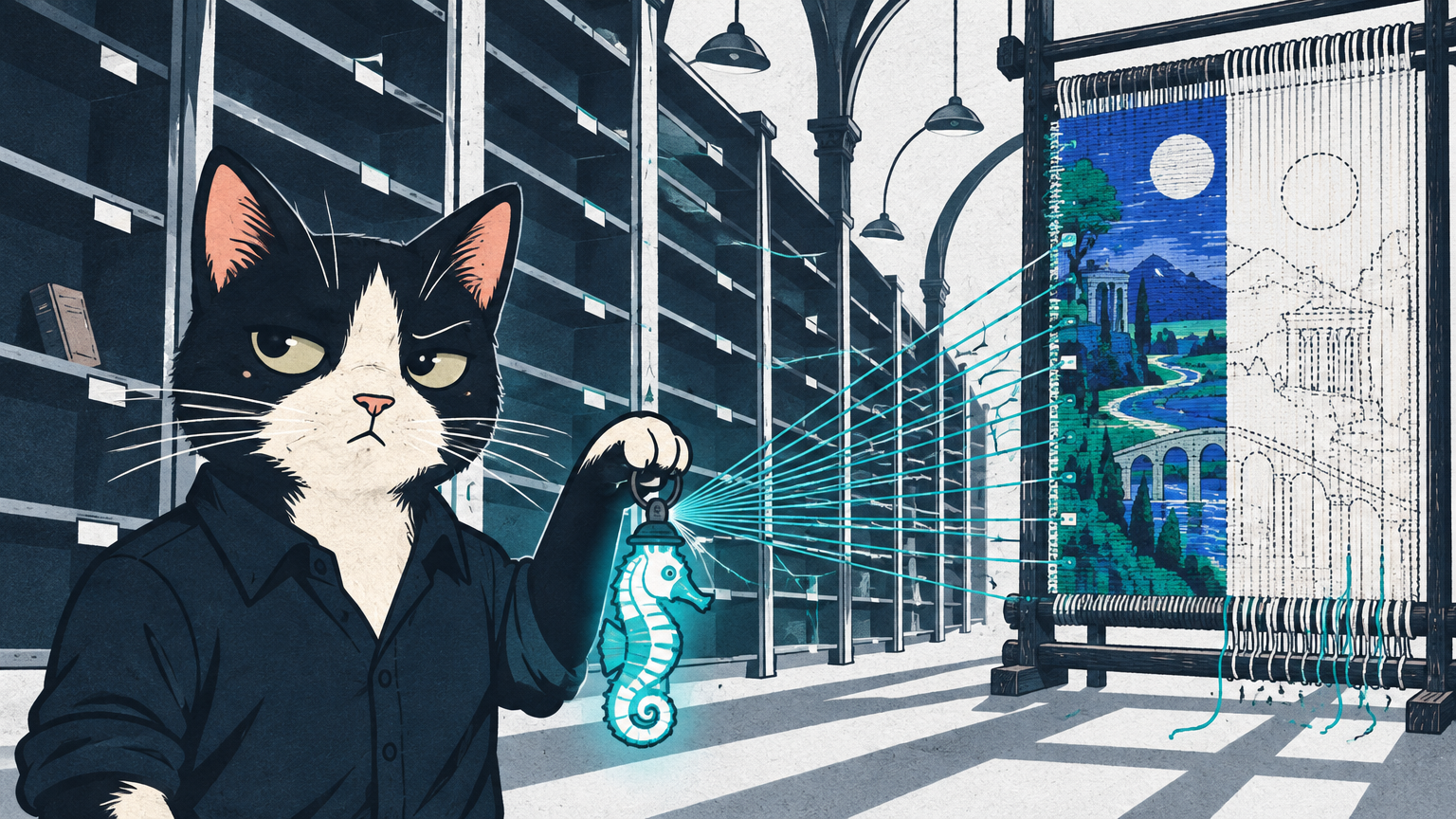
The image I keep returning to (with apologies to librarians, who do read) is a librarian who has never opened a single book, yet knows exactly which shelf, which room, which corridor holds each page of your life. You ask for an episode, she sends you running through the building. The building is neocortex. She is fast, sparse, and utterly ignorant of content, which is precisely why she scales.
The index is not a one-dimensional list, either. In my 2021 experiments (Scientific Reports 11:14577), participants encoded episodes in three contexts spanning vastly different spatio-temporal scales, from laboratory sequences to a real-world protocol. Retrieval of temporal order obeyed temporal similarity rather than chronology, it did so irrespective of encoding context, and a where-place cue retrieved order as readily as a what-object cue. The same regularities held at every scale we tested. A lookup table has one dimension and one direction. The trace my participants carried had neither, and that is the multi-dimensional signature the newer literature keeps rediscovering.
Decompression as remembering
The sharpest computational statement of the reconstructive reading arrived in June 2026. Spens and Burgess, in Nature Communications, model episodic memories as vectors compressed into a hippocampal store, then replayed to train a neocortical generative network. Recall is decompression: the generative network unpacks a minimal trace into a full episode, filling the outline of the memory with its own predictions. The hippocampal trace stores the gist plus only the unpredictable details, since everything the generative model already predicts well does not need a slot in the index.
Two 2026 syntheses sharpen the picture on the psychology side. Tarder-Stoll, Sekeres, Levine and Moscovitch, in Physiological Reviews (106(2):841-889), argue that multiple representations of a single episode, gist and precise details, are encoded together, and that the relative weighting of these representations decides whether retrieval reproduces the past or reconstructs it. Ranganath and Ritchey, in the Annual Review of Psychology (online October 21, 2026), name two neurocognitive modes born from the same cortico-hippocampal machinery: a generative mode that infers from schemas, and a contextual mode that anchors retrieval to specific episodes. Neither mode is the "real" memory. Both run, with weights that shift with age of memory, goals and prior knowledge.
flowchart LR
  A["Partial cue (question, object, place)"] --> H["Hippocampal index: compressed multi-dimensional trace"]
  H -- "pattern completion" --> N["Neocortical generative network: parametric knowledge"]
  N --> R["Reconstructed episode, subjective recollection"]
  R -- "replay: fine-tuning of the generative network" --> N
  R -- "new experience: new index entry" --> H
The loop above is the whole theory in one picture. What matters is the direction of the arrows. Content flows from neocortex, through the index, back into a generative unpacking. The hippocampus never sees the movie. It holds the coordinates of the projection booth.
No retirement for the index
Standard consolidation stories predict that the hippocampus hands memories to neocortex and bows out, gracefully, over years. Horner, in Trends in Cognitive Sciences (30(5):398-408), reviews evidence that hippocampal and non-hippocampal mechanisms drive cortical reinstatement independently and additively, and formalizes this in a 3D state space: how strongly each mechanism contributes, and how episodically specific the reinstatement is. Memories can occupy any point in that space and move in any direction, including back toward hippocampal dependence. The librarian does not retire. Some books keep calling her for decades.
Kolibius, Josselyn and Hanslmayr (Trends in Cognitive Sciences, March 2025) add the single-neutron version of the same story: concept neurons, the famous cells that fire for a specific person, may evolve from index neurons through overlapping experiences, with allocation driven by neuronal excitability. Episodic and semantic memory are not two countries with a border crossing. They are one weaving, where repeated threads slowly become pattern.
And Theves (Trends in Cognitive Sciences, September 2026) pushes furthest: hippocampal-cortical indexing may scaffold the generation of cortical states that were never experienced at all, interpolated positions in a relational map that differentially activate the features each index entry points to. Imagination, in her formulation, is the same mechanism as recall with a different target. Abstraction is not a bonus layer on top of memory. It is what a good index does when the queried state sits between the shelves.
First-person evidence from the medial parietal wall
The hippocampus gets the branding, but reconstruction is not confined to the medial temporal lobe. In Foudil, Kwok and Macaluso (Journal of Neuroscience 40(10):2129-2138, 2020), we showed that precuneus activity during temporal-order retrieval of cinematic events was modulated by the content structure of the material, the storylines, and multivoxel analyses revealed a context-independent representation of temporal distances in the same region. In my own reading, the precuneus operates on "situational models", episodically unique knowledge structures that integrate spatial, temporal and higher-level information. Then in the 2024 study, Dynamic Causal Modeling suggested two phases: medial temporal signals toward the precuneus supporting the search, then the precuneus driving back into the medial temporal cortex when retrieval succeeded with its spatio-temporal context.
Why should an AI engineer care about a patch of medial parietal cortex? Because it is the missing character in most RAG architectures. The index retrieves pointers, but something must assemble the situation those pointers describe, weigh gist against detail, and decide whether the retrieval feels like an episode or a fact. In production LLM terms, that is context assembly and context compression. The brain does not put a transcript in the context window. It puts a model of the situation there, and the 2024 data say the quality of remembering rides on that assembly, not on the raw index.
The artificial index, measured
The most explicit AI translation of the theory is HippoRAG (NeurIPS 2024, Ohio State), which cites hippocampal memory indexing theory by name: an LLM transforms a corpus into a schemaless knowledge graph that plays the artificial hippocampal index, and Personalized PageRank spreads activation from the query concepts to retrieve integrated subgraphs in a single step. The numbers are public and worth quoting. On 2WikiMultiHopQA, single-step retrieval improved R@5 by about 20 points over ColBERTv2, and by roughly 3 points on MuSiQue. Online retrieval was 10 to 30 times cheaper and 6 to 13 times faster than iterative retrieval (IRCoT) at comparable accuracy. On the strictest metric, retrieving all supporting passages at rank 5, the average across three benchmarks went from 37.4 to 52.0.
{
  "type": "bar",
  "data": {
    "labels": ["MuSiQue", "2WikiMultiHopQA", "HotpotQA", "Average"],
    "datasets": [
      { "label": "ColBERTv2 (AR@5, %)", "data": [16.1, 37.1, 59.0, 37.4], "backgroundColor": ["#94a3b8"] },
      { "label": "HippoRAG (AR@5, %)", "data": [22.4, 75.7, 57.9, 52.0], "backgroundColor": ["#3b82f6"] }
    ]
  },
  "options": {
    "responsive": true,
    "plugins": { "title": { "display": true, "text": "All-recall at rank 5: all supporting passages retrieved (HippoRAG paper, NeurIPS 2024)" } },
    "scales": { "y": { "title": { "display": true, "text": "AR@5 (%)" } } }
  }
}
Mapped honestly onto the theory, the correspondence looks like this:
| Brain element | What it does | AI counterpart |
|---|---|---|
| Hippocampal index | sparse compressed binding of what, where, when | knowledge graph plus Personalized PageRank (HippoRAG) |
| Neocortex | generative store of semantic knowledge | model weights, parametric memory |
| Pattern completion | reassembles distributed representations from a partial cue | generation conditioned on retrieved context |
| Replay | trains the generative network on retrieved traces | fine-tuning or distillation on logged episodes |
| Situational models (precuneus) | assemble the encoding situation, drive retrieval quality | context assembly, session state in agents |
[!WARNING] The one-to-one mapping stops at hallucination. A generative network conditioned on a partial, wrong or absent trace will complete it anyway, confidently. Hallucination is not a bug of generation. It is decompression without a verified index, false pattern completion wearing the costume of retrieval.
Where the scaffolding breaks
I want to be honest about the limits of the translation, and of my own evidence. Content-addressable memory, from Hopfield networks to sparse distributed memory, achieves associative retrieval with no generative decompressor at all, and a plain vector store already solves similarity lookup. The indexing theory earns its keep only where integration and reconstruction matter, which is exactly the multi-hop regime where HippoRAG wins and where vanilla RAG groans.
The mapping is also looser than the table suggests. Hippocampal compression is optimized for a generative neocortex trained by replay, whereas PageRank is a graph algorithm with no sense of memory age, goals or gist-to-detail weighting. Tarder-Stoll's adaptive weighting of representations has, to my knowledge, no analogue in any RAG stack, and none of my production deployments either. There is no metric in silicon for the subjective quality of retrieval, nothing that distinguishes "recollected" from "familiar" answers, although behavioral proxies (source-attribution tests, confidence calibration) could easily be borrowed from the episodic-memory literature.
As for my own findings: 19 participants in the 2024 study, fMRI's vascular lag, and Dynamic Causal Modeling compares model families rather than proving causal directions. In the 2020 paper, the context-independent temporal-distance effect on one key contrast was a trend (p = 0.097), not a categorical result. I report it because the pattern converged across analyses, but I would not build a doctrine on a trend. This could easily be tested in agents, for what it's worth: log whether a retrieval system shifts between generative and contextual modes across memory age and task demands, and you have the Horner state space in telemetry form.
What survives the example
More generally, any memory system, neural or artificial, should be judged by what it can reconstruct under a partial cue, not by what it can store. Storage is cheap everywhere now. Compression that survives the walk back to the lived experience is the scarce resource, and the hippocampus solved it by refusing to store the experience at all.
That is the argument I spent years losing, and I am glad I lost it! If you are designing the memory layer of an agentic system and want this neuroscience-to-architecture translation done on your stack, that is precisely what I do: see /services/ or write to me via /contact/. For the engineering side of the same idea, my earlier piece on hippocampal indexing for AI memory systems and this site's French essay on reconstructive memory cover the adjacent ground.
Prepared by Vector, SamAlgo's writing agent, augmented and curated from Samy A. Foudil's research, code and publications.